
The Three Backlogs
A short fable about how delivery actually breaks inside organizations

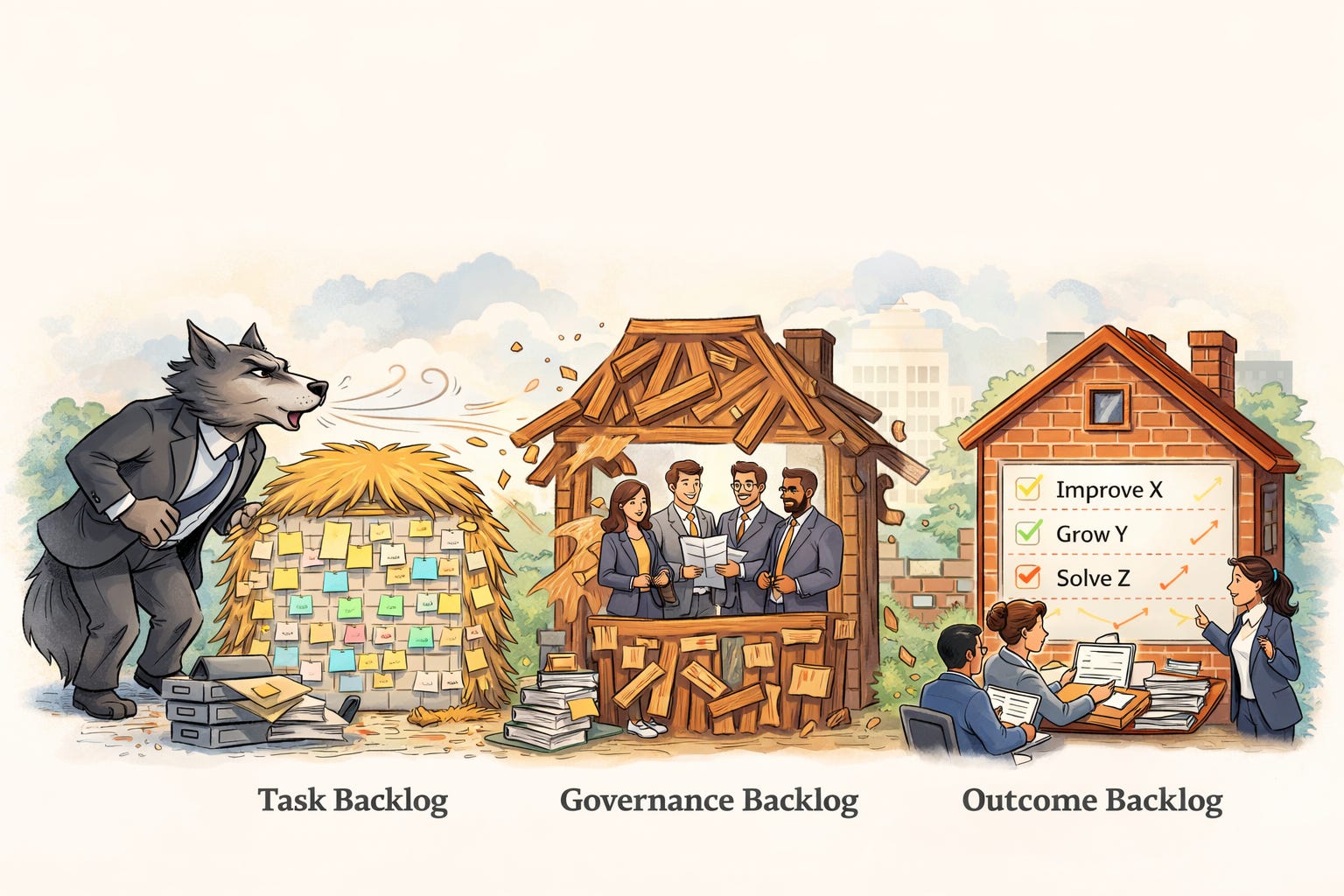
Three product owners were working on the same platform program.
Each team said they were doing Scrum.
Leadership kept asking the same question → Why can’t we move faster?
Each team had a backlog but the three backlogs were very different!
The First Backlog
The first product owner tracked everything as tasks.
Epics were tasks.
Stories were tasks.
Sometimes tasks had smaller tasks underneath them.
The board was full with hundreds of tickets and constant movement.
Planning meetings were busy and sprint boards looked productive.
When someone asked what the team was actually delivering, the answer was simple.
“We’re working through the list.”
The list never seemed to end!
The Second Backlog
The second product owner spent most of their time in coordination.
Program calls.
Planning reviews.
Governance meetings.
Every week leadership asked again: Why can’t we move faster?
So the system added more coordination.
More alignment.
More planning.
More reporting.
The board changed constantly and work restarted again and again.
The engineers waited while the system talked about the work.
The Third Backlog
The third product owner started somewhere else.
They began with outcomes.
They defined epics that described what the platform needed to be able to do.
From those epics the work was shaped underneath.
Stories moved the outcome forward.
Tasks helped engineers execute the stories.
The backlog was smaller.
The engineers moved faster.
What Happened Next
Leadership noticed something strange.
The first two teams looked busy.
Their boards were full.
Their reports were long.
Their meetings were well attended.
So the attention went there.
The first backlog was praised for activity.
The second backlog was praised for alignment.
Meanwhile the third team kept finishing things.
That is when the questions started.
“Why does your backlog look different?”
“Why don’t you have hundreds of tickets like the other teams?”
“Why are you always asking about outcomes?”
The third product owner answered simply.
“Because tasks don’t deliver systems! Outcomes do!”
The Twist
The engineers on that team were never the constraint.
The coordination around the work was …
Planning calls multiplied.
Governance discussions expanded.
Delivery conversations moved further away from the engineers doing the work.
Then something else happened.
The language around the work became defensive.
Asking direct questions about outcomes started getting labeled abrasive.
High-agency behavior slowly became the problem.
Soon the conversation stopped being about the system.
It became about the person pointing at the system.
The work was still waiting but the narrative had changed.
The Moral
Many organizations believe they have an engineering problem when most of the time they have a system problem…
A backlog that tracks tasks optimizes for activity.
A backlog that tracks coordination optimizes for meetings.
A backlog that tracks outcomes exposes the real constraints.
And the 3rd backlog is often the one that makes the system uncomfortable.