
The Terminology Changed
But the Nuances Matter!

Taking a moment to explain my video from today.
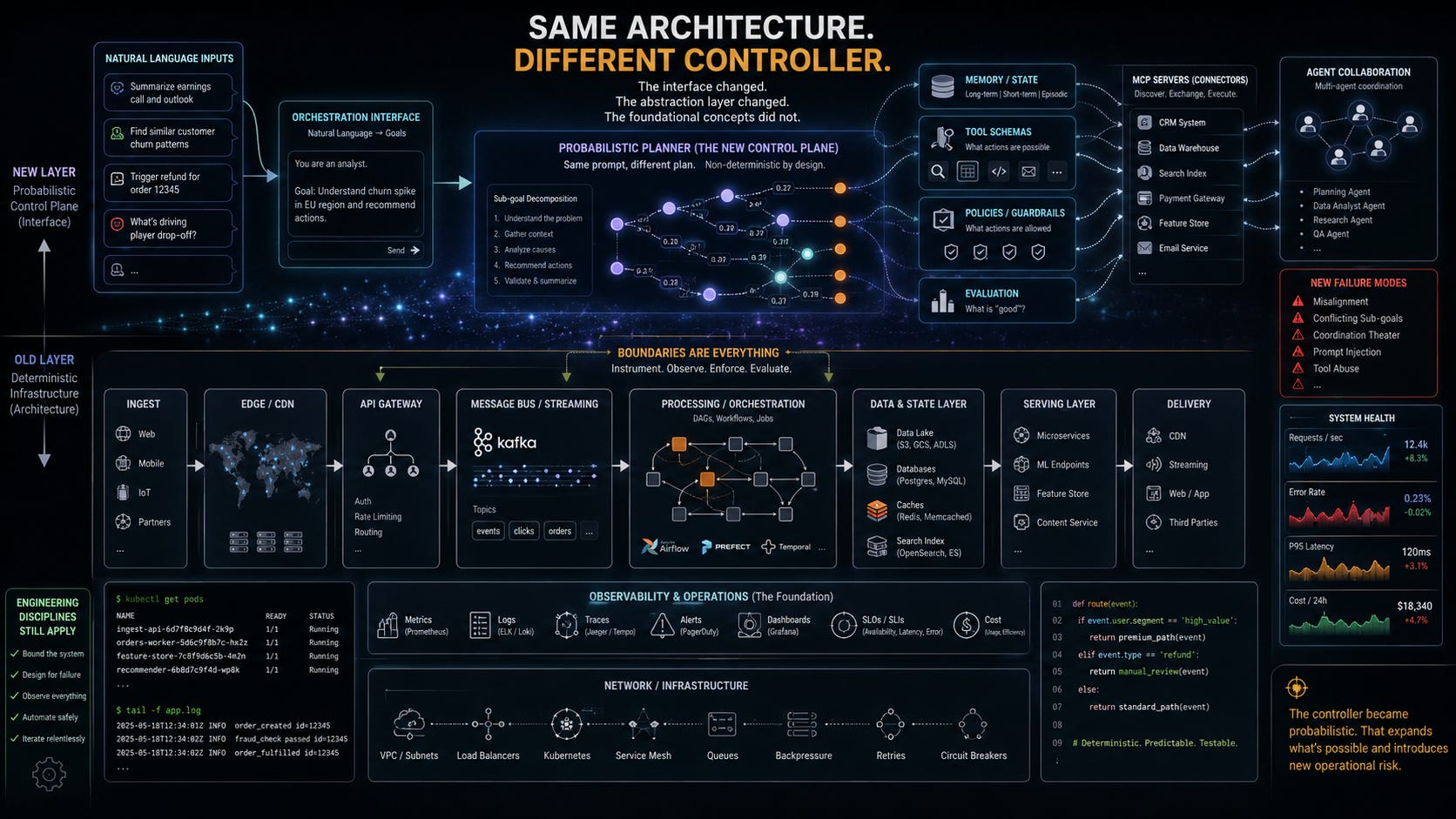
The Architecture is Familiar → Only the Interface Changed
If you have built distributed systems, data pipelines, ML platforms or enterprise integrations, most of what people call “agentic architecture” will look structurally familiar. Not identical but familiar.
The panic in engineering and product circles right now is real and the reasoning behind it is mostly wrong.
Terms like agentic workflows, orchestration, memory systems, MCP servers and multi-agent architectures get presented as if we discovered a new branch of computer science. Which we have not.
If you have worked in gaming infrastructure, ad tech, enterprise platforms or ML pipelines then you have already seen and built the underlying patterns. The terminology inflated while the macro-architecture did not fundamentally change.
The core loop is the same one that has existed for decades: ingest inputs, route work, transform and enrich data, retrieve context, execute actions, observe outcomes, optimize the loop. What we added on top of that is a probabilistic planner and natural language orchestration. This addition expands what workflows can do and breaks a meaningful set of assumptions we used to rely on. Reality is that both things are true simultaneously and are not mutually exclusive.
I believe that the people who should be most calm right now are experienced engineers and operators. Systems thinking still applies and for the most party only the interface changed.
What Is Actually New and Why It Matters
Saying “it is familiar” is not the same as saying nothing changed. The shape is recognizable and the control plane is different in ways that matter operationally.
Glossing over this will get you into trouble.
Classic workflow engines are closer to “if X then Y.” Agentic systems add a planner that can pick different steps from run to run, create intermediate sub-goals and change routing decisions based on fuzzy semantics. Same prompt just a different plan. This means you cannot test “expected inputs yield expected outputs” the way you would for a deterministic pipeline. You need evaluation harnesses, bounded autonomy and policy enforcement baked into the architecture from the start.
Agentic systems do not remove engineering work either and instead relocate it. You spend less time writing hand-coded glue between deterministic steps and more time designing the system around a probabilistic controller: tool schemas that define what actions are possible, policies and guardrails that define what actions are allowed, memory and state design that determines what the system can reliably recall, evaluations that define what “good” means in measurable terms and observability that tells you what actually happened and why.
Experienced operators should feel calmer about this shift
People talk about MCP servers as if they are a new reasoning layer. MCP is connector architecture. It standardizes how an AI host discovers tools and exchanges context with external systems, which is genuinely useful but it does not solve planning, correctness or safety. Conflating the protocol boundary with the agent’s decision-making is one of the more common ways teams build a false sense of security early in a build.
The multi-agent analogy to distributed systems holds in a lot of places: concurrency, coordination, shared state, retries, backpressure, observability, ... Teh catch is that distributed systems components are mechanistic. Agents are goal-driven and partially opaque, which changes how coordination breaks. In distributed systems you fight partitions, consensus failures and backpressure. In multi-agent systems you fight misalignment, conflicting sub-goals and what I would call coordination theater, where agents agree with each other and converge on a bad plan. Prompt injection becomes an operational security concern. This means that your distributed systems instincts are the right starting point but they are not sufficient on their own.
The Thesis Without Overclaiming
The architecture is structurally familiar, the interface is now cheaper and the controller is now probabilistic. This probabilistic controller expands capability while introducing a new class of operational risk.
Engineering has now shifted into orchestration, state management, evals and guardrails.
Tips for Building
Some food for thought for builders...
Always bound the action space first!
Define tools cleanly and make unsafe operations impossible by default rather than just discouraged.
Treat memory as infrastructure.
Decide what is source of truth and what is derived state, version it and audit it. Do not treat it as a scratchpad.
Instrument the boundaries.
Log tool calls with inputs, outputs and timing and capture the plan trace wherever you can.
You cannot debug a probabilistic system without knowing what it decided and when.
Evaluate continuously and regression test behavior (not only the code).
Track correctness, latency, cost and safety as first-class metrics.
Design human override paths from the start. ( Escalation and fallback are not features you add later.)
Closing
If you have built production systems then you are not behind. Instead you are watching familiar patterns acquire a new interface and a new set of edges.
Just remember that the interface changed as well as the abstraction layer. The foundational concepts did not and the operational assumptions built on top of those concepts need to be revisited.
Complacency is not and option because the work is still real; however, staying calm is the correct posture.