
How Big Tech Turned Cleanup into “Transformation”
The AI Excuse

Everyone’s losing their minds again today!
Another headline and viral posts following with claims of “AI came for YouTube’s employees.”
It didn’t! Complexity did.
If you’ve ever worked inside a “scaled-to-death” tech org you could see this coming ten thousand miles away.
My close friends in manufacturing and industrial engineering have been railing about this for years. The same inefficiencies that kill throughput on a factory floor eventually show up in digital ones! (Yes, I’m talking more Goldratt, less Gartner.)
They kept saying, “It’ll all come to a head one day.”
Well, here we are.
Let’s start with facts
Alphabet just reported its first $100 B quarter.
Revenue up 16 % year over year.
Cloud up 34 %.
Net income up 33 %.
YouTube ads at $10.3 B, up 15 %, its fastest growth yet 【AP News / Music Business Worldwide】.
These don’t depict a company in crisis but they do indicate a company clearing drag before it trips on its own shoelaces.
CEO Neal Mohan said it himself:
“We’ve grown in size, scope, and complexity over the years, but our core leadership structure hasn’t evolved in a decade.”
Then came the part everyone misquoted:
“Looking to the future, the next frontier for YouTube is AI, which has the potential to transform every part of the platform.”
Then BOOM! —> LinkedIn lit up like a Christmas tree of bad takes and the faux influencers and experts came out of the woodworks.
What actually happened
YouTube is splitting into three orgs:
Viewer Products
Creator & Community Products
Subscription Products — effective Nov 5 2025.
No layoffs and a voluntary exit program for U.S. staff ready to move on (See Business Insider / Times of India / LAmag)
This is not “AI taking jobs” as it’s clearly org-debt finally being refinanced.
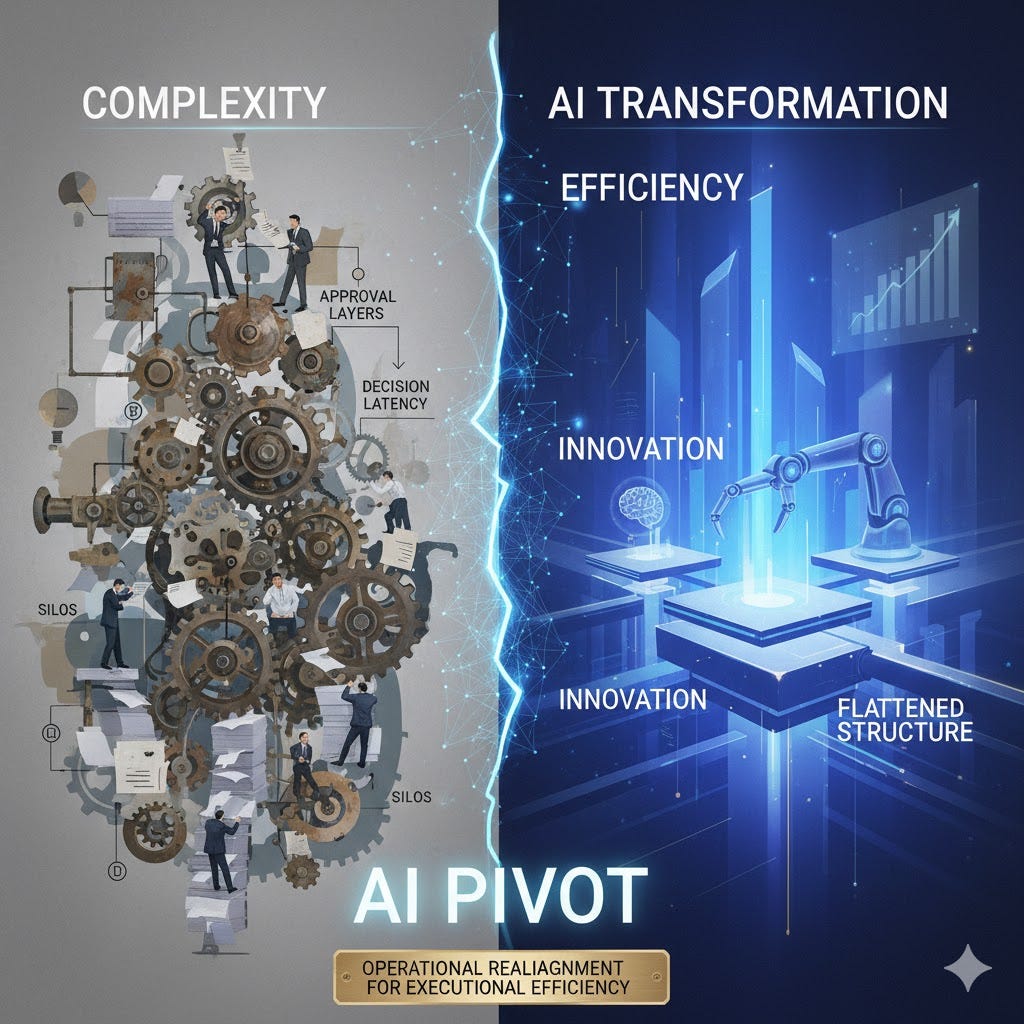
When you scale for ten straight years, bloat creeps in quietly and approvals multiply. PMs start managing PMs and decision quality and velocity dies in the darkness.
In other words, this reorg isn’t panic like “Oh crap AI is here we need to react immediately" or die off”
It’s plumbing!
Why the AI spin
First and foremost “AI transformation” sounds visionary.
“Fixing decision latency” sounds like homework while AI gives executives narrative oxygen:
It keeps investors euphoric.
It reassures employees it’s not a cost-cut.
It reframes correction as innovation.
If “AI” weren’t hot the memo headline would read something drab like
“Operational realignment for executional efficiency.”
Good luck getting Wall Street to clap for that one@
The pattern across Big Tech few are Discussing
YouTube is only Exhibit A.
Exhibit B – Meta and their ‘Year of Efficiency’
In March 2023, CEO Mark Zuckerberg officially declared 2023 the company’s “Year of Efficiency,” noting they’d “scaled back budgets, shrunk our real estate footprint and made the difficult decision to lay off 13% of our workforce.”
The cuts included roughly 10,000 roles in 2023, following ~11,000 in 2022.
The strategy explicitly pointed to flattening management layers and improving decision velocity (by removing layers no longer serving the purpose).
Same cleanup with new headline → The AI pivot came after the “efficiency” groundwork.
Exhibit C – Amazon and AI Re-Prioritization
Amazon announced plans to cut about 14,000 corporate roles globally in October 2025, citing ramped-up AI investment and the need to “move as quickly as possible.”
The move affects functions across devices, advertising, HR, Amazon Web Services and more with non-warehouse “corporate” headcount in focus.
The company’s messaging links these cuts to “reducing bureaucracy … shifting resources to our biggest bets (generative AI).”
Same logic! Optimize SG&A and operations first, wrap it in the “AI refocus” narrative second.
Exhibit D – Microsoft and Copilot as Cover Story
Microsoft’s FY 2025 Q1 reported revenue increase of 16%, with operating income up 14%, driven by growth in cloud, business processes and “AI infrastructure.”
Messaging from Microsoft centres on “Cloud and AI strength driving results” and major CapEx investments in AI hardware and infrastructure.
Behind the scenes: Analysts attribute margin gains partly to flattening internal structures, consolidating product lines (Office, Windows, Azure) under “Copilot + AI” branding → fewer management layers, fewer handoffs. (While Microsoft doesn’t publish “we cut those layers” as a headline, the pattern is consistent across filings and commentary.)
Narrative genius→ Real AI tech + real consolidation = a moonshot story and a clean-up job.
The Quiet Confession Behind Every “Transformation”
Let’s be honest, a lot of this is a balance-sheet hack wrapped in a redemption arc.
Each announcement is half strategy, half apology with an unspoken admission that
“We built too wide, layered too deep and slowed ourselves down.”
AI didn’t cause those mistakes but it gave leaders the perfect excuse to fix them and get rewarded for it.
Wall Street adores it:
Fewer layers → lower SG&A
Smaller teams → better margins
“AI investment” → CAPEX halo effect
When execs say, “AI will transform every part of our platform,” what they usually mean is,
“We’re about to make the hard cuts we delayed for years but this time the market will cheer.”
This is not cynicism because it’s literacy.
AI has become the “lingua franca” of correction and I’ll give them credit because it is progress.
Executives in MAANG are finally admitting, in coded language, that their machines got slow. So they’re cleaning them up during the one era when doing so earns applause instead of panic.
The Real Story
Big Tech isn’t being eaten by AI but is is being re-optimized for it.
It’s all about re-wiring.
YouTube’s shift, Meta’s efficiency drive, Amazon’s “AI focus,” and Microsoft’s Copilot consolidation are all the same move:
Scale → Stall → Cleanup → Rebrand as AI.
AI didn’t replace people or lay them off; however, it did replace excuses.
TL;DR
Record quarters across the board.
No crisis, just overdue structural cleanup.
AI = real capability + convenient narrative.
Leaders finally admit: complexity killed speed.
The market rewards the confession → as long as you call it “AI transformation.”
Personal Note
I’ve sat in those rooms as an observer.
I’ve watched decks morph overnight from “Operational Realignment” to “AI Readiness.”
It’s all the same content with swapped buzzwords.
And honestly? It’s fair.
If this is what it takes for companies to admit their structures broke, I’ll take it! Real transparency died a long time ago.
Furthermore, let’s not pretend there’s no collateral damage.
Over the past two years, these “efficiency” and “AI transformation” cycles have impacted well over 100,000 people across Big Tech —> from Google and Amazon to Meta, Microsoft and YouTube.
Engineers, designers, ops teams, HR, QA … the people who poured their soul into building the systems now being “restructured.”
Yes, the orgs needed cleanup but we can’t forget that behind every “voluntary exit,” “realignment,” or “AI pivot,” there’s a human cost.
Clarity (even when it’s wrapped in hype) is still progress while empathy is the part too many of these “AI transformations” forget to optimize for.
This article comes at the perfect time, providing such a clear, Goldratt-esque analysis of what's trully driving these tech giants to streamline operations. It makes me wonder, how much of this misinterpretation stems from a lack of systems thinking compared to the prevailing anxieties around AI’s impact on employment, and I trully appreciate your insightful breakdown.