
AI Collapses Structure Before It Creates Advantage
AI does not primarily create speed → It collapses structure!

When feedback loops compress any weaknesses surface immediately.
Organizations that pursue velocity inside legacy workflows are amplifying fragility.Organizations that redesign workflow into an agentic operating system create leverage.
Old Ways vs. New Ways
AI compresses execution latency.
Feedback cycles that once took weeks can now close in minutes and errors now propagate before governance forums even convene.
AI compresses role boundaries.
Agents draft specifications, generate code, test changes, deploy updates, monitor behavior and triage incidents. In other words, handoffs that once defined organizational clarity begin to blur.
AI compresses information asymmetry.
Data that once moved slowly through reporting layers now becomes visible in real time → i.e. Bottlenecks reveal themselves instantly. (Drum, buffer , rope!)
When these forces combine the old workflow cannot absorb the pressure and in turn, if the structure remains unchanged instability will accelerate.
The Illusion of Speed
The first instinct in many organizations is t create an automation layered on top of existing flow.
Agents generate specifications.
Agents write code.
Agents deploy.
For the most part, the architecture beneath remains untouched.
Constraint overload rears its head when GPU clusters saturate or human review queues spike because throughput was never mapped prior to automation.
Ambiguity around decisions emerges when override authority is unclear since ownership relied on slower escalation paths. (Think highly regulated industries where 90% of the work is compliance and performative control over it)
Cost volatility increases when retries multiply or tool chains cascade without boundaries which drives unpredictable compute spend. (It’s always forgotten that there are cost impacts outside of token usage.)
Governance lags behind drift because compliance cycles were designed for quarterly change rather than minute level iteration. (i.e. highly regulated industries again)
None of these failures originate in the model itself because they are side effects from workflow design.
Roles Collapse Before Work Disappears
Traditional product flow separated responsibility and operates like this:
Product defined requirements.
Engineering built.
Quality assurance validated.
Operations monitored.
Support reacted.
Agent driven systems compress all of these separations of concerns into a single workflow that can draft specification, generate implementation, test output, deploy change, observe telemetry and initiate remediation.
The time buffer that once allowed interpretation disappears. Meanwhile, back at the ranch, accountability intensifies because agents do not make it disappear.
3 questions now determine stability:
Who owns outcome when an agent acts autonomously?
Who controls the release throttle that governs system pace?
Who has override authority when the model drifts from expectation?
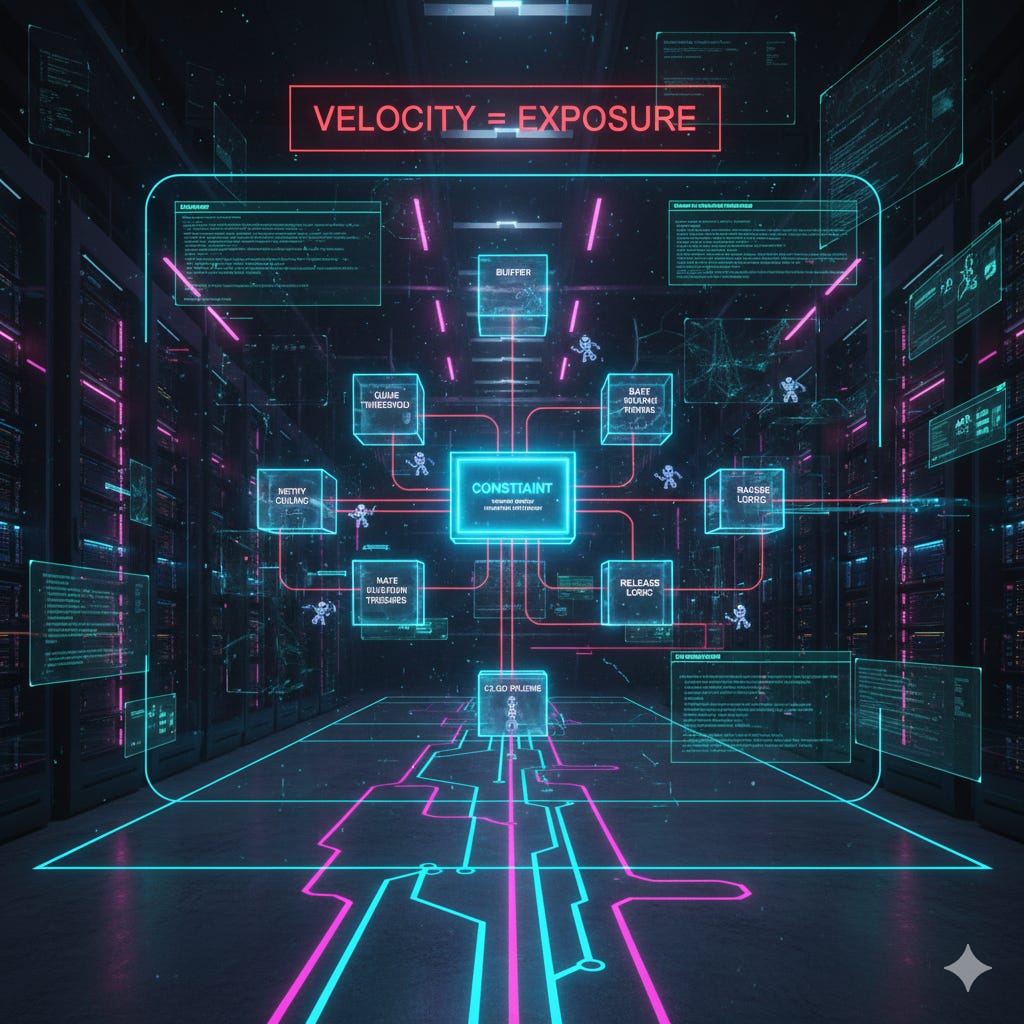
If these answers are vague then velocity becomes exposure.
Velocity = agents acting, deploying and deciding in minutes.
Exposure = visible failure, cost spikes, customer harm and regulatory risk.
Enter the Agentic Operating System
An agentic operating system is governance translated into executable logic.
Every system has a constraint that sets pace.
It may be GPU throughput, human review capacity, API rate limits, legal approval bandwidth and so on.
Every system requires buffers that absorb volatility.
Think queue thresholds, retry ceilings, escalation triggers and rollback mechanisms.
Every system requires release logic that controls how work enters flow.
For example, rate limiting policies, staged rollouts and automated guardrails enforce discipline.
Observability must trace prompt to response with latency metrics, drift indicators and cost attribution. In this case visibility is not reporting theater because it is necessary control.
Without explicit constraint mapping, buffer ownership, release governance, autonomy increases instability rather than leverage.
The Hidden Production Line Inside Every Model
Think of every model invocation as a miniature production system.
Prompt
Encoding
Inference
Tool invocation
Output
Feedback
Each stage consumes compute, time and cognitive bandwidth.
Side effects are that unbounded retries inflate cost, cascading tool calls multiply state transitions, invisible queues delay human correction and missing tracing conceals drift.
All this to say that waste in digital systems behaves no differently than waste in physical factories → The key difference is speed.
Exploration vs. Production
Exploration and Discovery tolerate unstructured variability that does not immediately map to customer harm or financial risk → production does not.
In discovery phases, variability can be useful especially when high signal diversity reveals opportunities. Loose pacing with strong observation is appropriate in this case
However, in production, the same variability destabilizes customer experience. This is when throughput caps, explicit buffers and strict release control become necessary.
Confusing these phases creates 2 risks.
Early rigidity that suppresses learning
Late chaos which erodes trust
Distinguishing exploration from production is now one ot the most important leadership responsibilities.
Leadership Under Compressed Consequence
AI has collapsed the time between action and consequence.
In slower systems, weak assumptions hid behind reporting cycles; hoever, in AI systems weak assumptions compound before the next meeting.
A flawed pricing rule can distort thousands of transactions in minutes.
A misconfigured agent can propagate errors across environments before anyone finishes a status update. This changes the risk profile because scale and speed now operate together in tandem.
Leadership can no longer rely on output reviews or retrospective dashboards.
Most responsibility shifts to structural control.
Leaders must know which constraints set system pace.
The constraint may be GPU capacity, human review bandwidth, API ceilings or regulatory throughput. In AI systems, leaders do not get to lead from altitude and title alone anymore. They must be able to step into the constraint and act (downward fluency is demanded).
Leaders must assign explicit ownership of buffers that absorb volatility.
If no one owns the queue threshold, the retry ceiling or the escalation trigger then instability spreads like a wildfire.
Leaders must define override authority before autonomy expands.
When a model drifts or an agent misfires someone must have the mandate to slow the system without debate.
Throughput, lead time, utilization, cost per inference, drift rate are no longer reporting artifacts because they are now control signals. If these are reviewed weekly the organization is already behind the system it built!
From Speed To Exposure
Speed amplifies whatever structure already exists.
If structure is weak, speed magnifies fragility
If structure is disciplined, speed multiplies precision
The deeper implication is uncomfortable.
AI does not introduce chaos into organizations → It removes the slack that once concealed it.
For years, slow cycles allowed teams to mistake delay for safety.
Buffer time masqueraded as control
Coordination overhead masked unclear ownership.
Now the “buffer” is gone.
We have moved beyond asking whether AI will transform the business and are now into whether your workflow can survive the rate at which consequences arrive.
In this environment, advantage belongs to teams that understand their constraints, protect their buffer and define their decision rights before failure tests them.
AI does not save weak operations or low agency! It reveals them at machine speed!